

Let’s get some common mortgage messages out of the way…
“Renting is throwing your money away.”
“Buying ties you down and locks up money that could’ve been invested.”
“When you buy a home, pay it off as fast as possible.”
“If you do buy, don’t pay off your home early. It’s better to invest the money.”
These are just a few of the ideas floating around the web. It makes the choices so easy, doesn’t it?
These difficult topics require slightly complex (but not scary-complex) answers.
Let’s dive into these topics and decide what’s best for you.
Buying Vs. Renting
Should you buy or rent? Well, the answer is straightforward. Wait, maybe not straightforward. I mean, the answer depends upon your situation and the current market, and there is no one-size-fits-all answer. That’s straightforward, right? Yeah, I know. I guess I don’t really understand what straightforward means.
I have no problem with people preferring buying or renting. The problem is that so many people think buying is always better. There is an influx of bloggers and people with nothing else to do who have suddenly decided that buying isn’t always better. So they’re trying to make it look like buying is always a terrible idea.
Obviously, if you see an article title that swings in one direction and against the other, it’s biased. They will only use examples that help their side. That being said, I acknowledge that it’s impossible to write an article that equally applies to everyone. I’ll try my best.
This topic is so highly debated that I’ve written a two-part series on it:
- Should You Buy or Rent Your Home? Part 1: Isn’t the Answer Obvious?
- Should You Buy or Rent Your Home? Part 2: Weighing the Pros and Cons
And did I mention that I also published an infographic about it?
A Brief Summary
I’m not going to recycle everything that’s in those articles, but I will give you a brief summary and tell you a few secrets that aren’t in those articles. (Shhh!)
So, let’s dive into this. There is an opportunity cost to each, but one will make more sense for your specific situation. And in some cases the answer really is obvious. If you move a lot for work, it’s probably a good idea to rent unless you want to have (and can afford to have) rental properties scattered everywhere. If you have always wanted your own home to do whatever you want with cosmetically, and you are financially free enough to afford to buy a home, you should buy. But for the rest of us, it’s not that easy.
Let’s make this tangible. Let’s talk about a formula you can use to determine whether buying or renting makes more sense financially. I emphasize “financially” in the previous sentence because you still have to look at what makes sense practically (e.g. moving often, special circumstances, etc.), and then there are emotions that can trump financially logical decisions as well.
Now for the formula: it’s called the price-to-rent ratio.
Price-to-Rent Ratio
To calculate price-to-rent, you divide the average price of a home by the average annual rent in the area. Since $300,000 is a good country-wide average price for a fairly nice home, we’ll use it as an example:
Price: $300,000
Rent: $1,500 per month = $18,000 per year
Price-to-Rent Ratio = $300,000/$18,000 = 16.6
Now I’ll explain what the heck you do with “16.6.” Investopedia breaks it down like this (and I tend to agree):
- Price-to-rent ratio of 1 to 15 = Much better to buy than rent
- Price-to-rent ratio of 16 to 20 = Typically better to rent than buy
- Price-to-rent ratio of 21 or more = Much better to rent than buy
In our example, the choice would be up to you, but at least you would know that you’re making a financially wise decision either way. For example, where I live, this ratio comes out to “10.” So, it would make way more sense to get a mortgage than to rent here. But I live in the Midwest, so it’s very different from much of the country. I’ve noticed that it seems to be better to buy in the South and the Midwest. And it’s usually better to rent on the coasts and in much of the North. Maybe it’s just me, but this seems to hold true.
It’s a good idea to run this ratio with several different numbers to get a strong idea of which option is better.
There’s even a calculator you can use to streamline this process.
So, Should You Buy or Rent?
If you account for everything, you’ll often find the ratio comes out similar, if not exactly the same. In that case, if you don’t want the responsibility and headache of home maintenance, rent. If you want to do whatever you want to every part of your home, buy. Of course, there are other factors, but this is assuming you’ve already gone through the basic reasons to do either one.
Many people still swear that buying is always the best option. However, renting is becoming a more favored option among millennials.
Afford Anything published a very popular article that favors renting if you would like to see that side.
However, the article is a little dramatic.
It explains how the “mortgages end, renting is forever” idea isn’t true, because of the extra things you pay for when you own your home, even after it’s paid off. I see where they’re coming from, but the example is a bit extreme. It gives an example of the life-long expenses you might incur with a $300,000 mortgage after it’s paid off, which are $1,581/month in their example. I happen to own a home worth close to that, and our monthly expenses, taking everything in the article into account, would be around $400/month after it’s paid off, so I think it goes a bit on the extreme of the renting side.
That’s all on buying vs. renting for now. Remember, there is no one-size-fits-all answer.
Types of Mortgages
Let’s say you’ve decided to buy – this article is about mortgages, after all. What are the types of loans, and which is best?
There are two basic types of loans. Let’s cover those first:
- Fixed Rate Mortgage – This is exactly what it sounds like. The interest rate is fixed for the duration of the loan. Nine times out of ten, this will be your best bet. It generally comes with the least amount of risk and the best rates over the long haul.
- Adjustable Rate Mortgage (ARM) – Unlike a fixed-rate mortgage, an adjustable-rate mortgage’s rate changes over time. It generally starts out lower than the average market rate, but it can go much higher than the market rate within a few years. There is a cap on how high an ARM’s interest rate can go. For example, a six-point cap means that if you start with a 3% interest rate, it can’t go above 9%, but 9% is a whole bunch of percent!
Again, it’s almost always best to go with a fixed-rate loan. Sure, the interest rate may go down in the future, but over the long haul, there’s a much better chance of it going up. And if you think interest rates are too high right now, just wait. Or you can refinance later. But they will go down eventually if they’re really high.
Now let’s talk about a few of your options…
Loan Options
- Conventional Loans – The most basic of all mortgages. Conventional loans are not insured or guaranteed by the federal government. You borrow money from a bank and pay it back. The interest rates are usually decent, but it requires a larger down payment than most options below.
- FHA (Federal Housing Administration) Loans – The rates are generally higher, but you can get them with a very low down payment. That translates to: “If you can’t wait until you’ve saved for a down payment, and you really want your home right now, regardless of home much it will cost you, get an FHA loan.”
- VA (US Department of Veterans Affairs) Loans – Loans offered to our Armed Forces. Though they will often finance up to 100%, the interest and fees are generally higher than conventional loans.
- Ballon Loans – Loans that offer a fixed rate (generally low) for a period of time, with low monthly payments. At the end of the period, the entire balance is due. They’re generally for investors or people looking to refinance before the end of the period.
- USDA/RHS Loans – Loans for people in rural areas, offered by the RHS (Rural Housing Service). They’re a good option if you buy a farm. There are many guidelines to get approved. A degree in agriculture helps you qualify. The specifics are on the USDA’s website.
Other types of loans exist, such as interest-only ARMs and Jumbo loans, but these have been highly uncommon since the housing bubble several years ago and are generally a bad idea.
Private Mortgage Insurance (PMI)
Private Mortgage Insurance (PMI) is generally required if you have less than 20% equity in your home. For example, if you buy a $100,000 house (mortgage for 100k and appraises for 100k), and you put 15% down (85k remaining balance – 15% equity), you would be required to pay PMI until you pay the house down to $80,000 (20% equity).
PMI is for conventional loans, whereas VA loans require no PMI, and FHA loans have their own insurance and fees for this purpose. But when you’re taking out a conventional loan from a bank, they don’t have the government or the VA backing anything. Therefore, they have to take precautions against you possibly not paying your mortgage.
PMI is generally 0.25% – 2% of your yearly mortgage balance. And once you hit 20% equity, you can contact your lender and have the PMI removed. Though the lender should do this automatically, you’ll want to ensure it happens. They will give you a statement in the beginning stages of the loan that will lay out how much and how long you have to pay until you hit the 20% equity mark. Keeping your pay stub organized will help you monitor your progress toward reaching this milestone.
How Amortization Works (And Why 30-Year Loans are Evil)
Amortization is “the paying off of debt with a fixed repayment schedule in regular installments over a period of time”, according to Investopedia. It’s a schedule that shows you your payment, broken down by principal, interest, and any applicable taxes or insurance in escrow.
This is a very important schedule. If you understand it, it can save you some money.
With a fixed-rate mortgage, you pay more principal and less interest as the loan matures. That means that making extra payments makes a much bigger difference at the beginning of the loan.
Thirty years is a long time to pay for a house. Go for a 15-year mortgage or even a 10, but you probably already know that. If you can’t afford to take out a mortgage shorter than 30 years, you can’t afford that house. Sorry if that hurts your feelings, but at least it doesn’t hurt your wallet.
If you currently have a 30-year mortgage and you can’t refinance, that’s ok! You can pay a little extra on a 30-year loan to pay it off quicker. Let’s look at how much extra you would have to pay to pay it off early – it’s not much.
Do the Calculations
This is the amount you would pay every month (for an 8%, $100,000 loan) to pay off your mortgage early:
- 30 years: $733.76
- 25 years: $771.82
- 20 years: $836.44
- 15 years: $955.65
- 10 years: $1213.28
Did you notice that there is only a $102.68 difference between paying off this loan in 30 years and paying it off in 20 years? That’s 10 years off your mortgage! Here’s a quick infographic showing the difference – for you visual people:

Figure out your numbers and how much you can save with Dave Ramsey’s free mortgage calculator. Check out this amortization calculator to see how your schedule works. Your bank can provide this as well.
Not only do you pay off your mortgage earlier with a shorter loan, but the interest rate is usually much lower. Why? Simply because the bank is “stuck” or “locked-in” at that interest rate for a shorter period of time
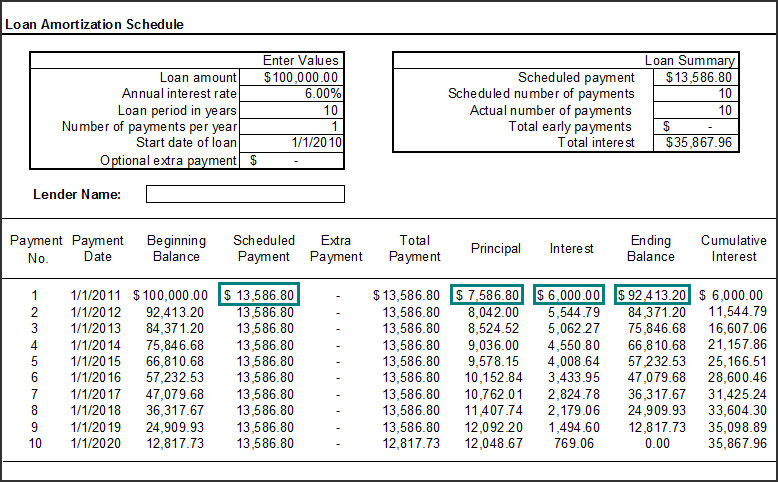
Here’s an example of a basic amortization schedule. You can see the principal and interest for each payment:
Should You Pay Off Your Mortgage Early?
Let me explain the two schools of thought on this:
- You should pay off your mortgage early because it will free up your monthly payment for other things (like investing) and help you to become financially free. This is true.
- You should NOT pay off your mortgage early because you will miss out on interest you could have received from investing that extra money. This is also true.
There you have it, two sides to the argument. And these are not the only two sides, just the most popular. Obviously, which one you choose depends on your financial goals.
This isn’t just about the numbers. Just like how some people prefer the debt snowball to the debt avalanche for emotional or mental reasons, the same applies here.
Here’s the short of it: If you want to be fully financially free of all debt, pay off your mortgage early. If it’s going to kill you to see all of that money going towards your home, instead of gaining interest in an investment, invest the money.
If you do decide to pay off your mortgage early, it should be the last debt you pay off.
Make sure you accomplish these things before you start paying off your mortgage early:
You could go a step further and max out your employer retirement account, but that’s a personal preference.
How to Destroy Your Mortgage Payments
OK, so you’ve decided that buying is the way to go, you’re using a mortgage to do it, and you don’t want to be stuck paying on your home for the rest of your life. Good choice. Here’s how to pay off your home early and quickly:
1. First day strategy
If you take full advantage of this strategy, it is one of the most powerful ways to dramatically shorten the life of your mortgage without paying extra (literally, you aren’t actually paying extra money).
You simply make your first payment on the day the loan is activated (the day the lender starts charging interest) instead of waiting until your first payment is due, which is usually over a month out.
This works so well because, this way, your entire first payment goes towards the principal. Principal payments have the most impact during the early years, especially this first payment.
It will make you sick to see how little of each payment goes to principal in the early years of a mortgage. On a $1,000 payment, as little as $20 or $30 each month goes to principal. The rest goes towards interest.
If you’re already a proud mortgage owner, you can still apply this strategy by simply making one extra full payment. It won’t have quite the same effect as it will on the first day, but you will still knock some serious time off your mortgage.
2. Split payment strategy
You’ve probably heard of it. Some people think it’s magic, but it’s actually a really simple concept.
You simply pay half your payment twice monthly instead of one full payment.
This works in 2 different ways…
- Paying half-payments every two weeks will cause you to automatically make one extra full payment every year. (26 half-payments per year comes out to a total of 13 full payments instead of the usual 12)
- You will lower the principal balance 26 times per year instead of 12.
You can usually set this up with your bank, but if they don’t do it, you can still take advantage of this strategy by adding a little extra to your principal each month or by making one extra full payment each year.
To figure this out for your mortgage, divide the principal payment amount (principal only, not escrow or interest) by twelve and add that amount to each month’s payment.
3. The Planned Increase-Payment Strategy
In this strategy, you’ll increase your mortgage payment each year by a certain percentage.
This requires discipline, but it’s highly effective. In some cases, it may not require discipline. Some financial institutions actually offer a way to set this up manually, just like you would for an investment account that increases annually, but many don’t offer this service. So expect to have to do it on your own.
The idea behind this method is that you will receive pay increases and, therefore, be able to make slightly larger payments each year. It can be an extremely valuable way to pay off any large loan early.
Infographic: Trulia